Rules
Overview and Objective
Each player has a team of 6 pieces of 6 different colors: white, black, blue, green, red, and yellow. Pieces generally move by moving to adjacent spaces or by jumping over other pieces; enemy pieces are captured when they are jumped. A player wins in one of two circumstances:- he captures his opponent's white, or
- he moves his white across the board to his opponent's white's starting position
Before the game begins, each player chooses three different Rules from the Rule list. These Rules are used throughout the game to extend the abilities of single pieces or of the whole team.
Board and Setup
Evasion is played on a modified Chinese checkers board in which 4 of the 6 home-base triangles have been sectioned off, leaving a diamond-shaped Evasion board. The first "layer" of the inner diamond and the last spaces on either side of the middle row are also sectioned off, so that the diamond's sides are 6 spaces long.Players set up pieces at either end of the diamond. The pieces are placed in the order shown below:
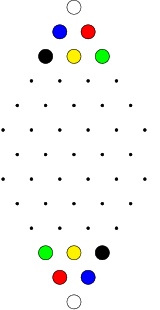
Players play in turns, and players can either decide between themselves who should go first or play rock-paper-scissors to decide.
You also have the option to use a chess clock when you play. This can help keep games moving and make sure games don't last too long. Typically, the clocks are set to ten minutes per player, but feel free to use as much or as little time as you would like.
Movement and Capture
Players make 1 move per turn. Non-Rule (conventional) movement consists of either (1) moving to an adjacent, unoccupied space or (2) jumping over an adjacent piece with an unoccupied space directly behind it, in the direction of the jump (as in checkers or Chinese checkers). A player may jump both his own and his opponent's pieces: when an opponent's piece is jumped, it is removed from the board unless a Power which says otherwise is invoked.Conventional movement cannot be backwards: pieces moving conventionally must step or jump either forward (diagonally) or horizontally. After performing a conventional jump, a piece may continue to jump over jumpable pieces. A piece which is allowed to jump adjacent pieces after a jump is said to have `bounce'. A piece which has just performed a conventional movement is said to be `landing'.
The White Piece, Zapping, and special circumstances
The game ends when either (1) one player's white piece is captured or (2) one player's white piece lands in the opponent's white's starting position.When a player's white lands on the fourth row from his opponent (the 10th row from his perspective), any pieces in the opponent's home base (the rows in which his pieces began) are immediately captured: they are said to be `zapped'. No special rule can protect you from zapping. This is to guard against camping of the home base.
If you happen to cover up your own goal with one of your non-white pieces, you can just remove the piece from play or just have white ignore it.
Special Rules
On the following pages, there is a list of special rules used to enhance the game. Before the game, you and your opponent choose three rules from the following list. These rules give the game variety; with just a handful of rules you get hundreds of combinations, so you could play a different game each time. The rules vary in scope and effect: some apply every turn, some are only used once or twice a game, some grant greater offensive capabilities, others improve your defense, and others are used to trap your opponent or trick him or her into a dangerous situation. When choosing rules, think about how the rules play with and against each other, and how certain rules might or might not fit your style or give you the expressiveness in play you want.Some rules are assigned to a specific piece (of your choosing). You may not put two of these kinds of moves on a single piece (for example, one may not have both armor and jolt on his yellow piece).
Rules are intended to make the game more fun, interesting, and deep. Players are encouraged to develop their own Rules, sets of Rules, and strategies based around them. We have found that using the following guidelines to help us come up with rules that make the game more interesting and keep it fairly balanced:
- Avoid making Rules that affect white
- Avoid making Rules that tend to stall the game excessively
- Shoot for rules that are both fun to play with and against
Torus
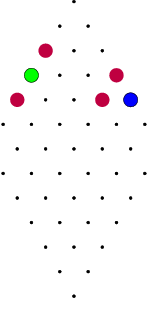
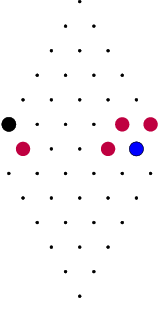
Designate a piece to use this power. This piece treats the board as if it wraps around horizontally. That is, if the Torus piece is on the edge, it can move to the opposite edge of the same row, and can jump similarly. Further, when this piece encounters an edge moving forward, it may move forward as if it were in the opposite spot on its row (illustrated below). Below, the blue piece is your torus, and the purple spots are its available moves.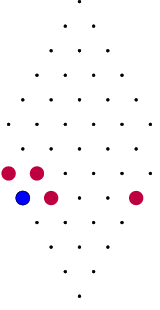
Armor
Choose one piece to be your armored piece. This piece must be jumped twice to be removed.Caboose
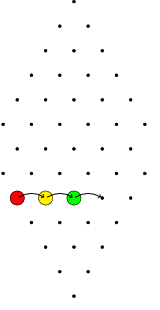
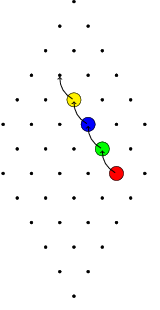
If three or more of your nonwhite pieces line up in a row, you can use your turn to advance all the pieces one step in the direction of the line.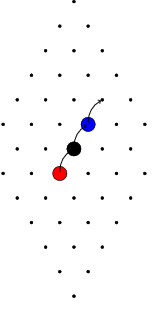
Nonagression Pact
Once during the game, at the beginning of your turn you may choose two non-white pieces (one of yours, one of your opponent's) which may not interact for the remainder of the game. This means that the two pieces cannot jump one another and cannot use any special rules against the other.Conversion
Designate one piece to be your converter. The first enemy piece this converter jumps loses any associated powers, and becomes one of your pieces. Any additional opponent pieces jumped are just captured as usual (unless another rule states otherwise). Note that if you first jump an armored opponent, the piece is converted even though the opponent piece has armor.Teleporter
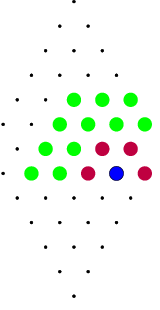
Choose a piece to be your teleporter. This piece can move regularly, or it can use the power of teleportation. If the power is used, the teleporter may move to any open space not behind it within three spaces of itself. When the power is used, the pieces over which the teleporter moves are not considered jumped.Below, the blue piece is our teleporter, and all spaces he is able to move to are highlighted. The jumps drawn below indicate that the teleporter can also move regularly to these spots using the standard movement rules for jumping. A space is highlighted green if the piece can move there by means of teleporter, purple if the piece can only move there by teleporting or regular movement, and red if the piece can only reach the spot by moving regularly.
Mad Hatter
At the beginning of your turn you may choose two nonwhite pieces of yours and swap their positions. Afterwards, you may move or otherwise continue your turn. You may use another special rule after using mad hatter. You may only use this power once per game.Grim Reaper
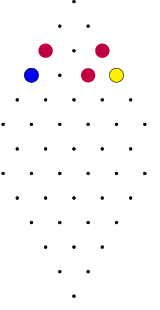
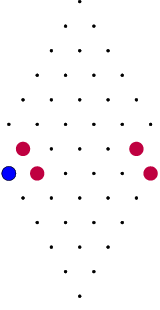
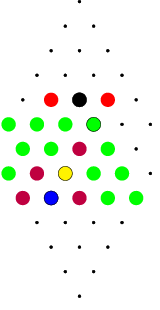
Choose one piece to be your Grim Reaper. When one of your non-Grim Reaper (and nonwhite) pieces is removed, the Grim Reaper moves to the spot where that piece was at the end of the turn. If multiple pieces of yours are removed on the same turn, the Grim Reaper goes to the place where the last piece to be removed was.Below, the black (which is your Grim reaper), red and blue pieces are yours, and the green is your opponent's. The images show the progression of a turn in which one of your pieces is captured.
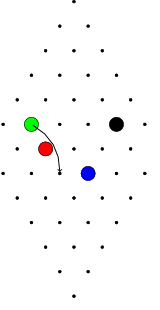
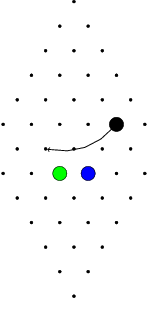
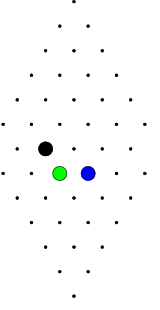
In the above, the green takes your red, and when the turn finishes, your black moves to where your red was.
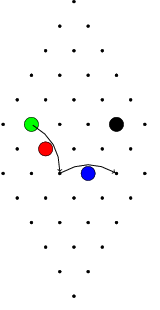
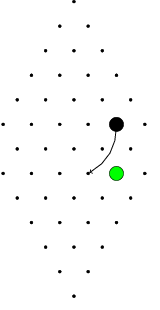
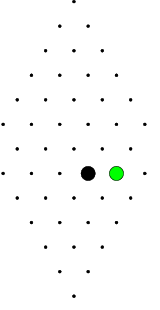
Here, the enemy green captured your red and then your blue, so the black moves to where the last piece to be taken was.
Jolt
Designate one piece to be your Jolt. When this piece jumps over any of your nonwhite pieces (`jolts' them), you can move the jumped-over piece using a standard move (that is, the piece may move normally except for that it is not allowed to use its power(s). If you jolt more than one piece, you must move them in the order in which they were jumped (if you choose to move them).Below, the yellow is your jolt, the blue is your teleporter, and the red is also your piece. The green and the black belong to your opponent.
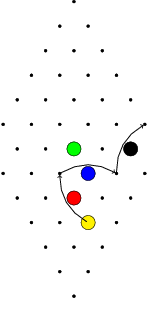
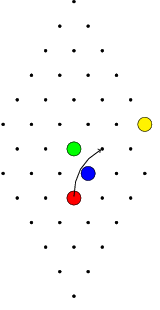
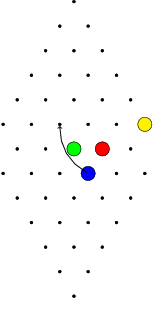
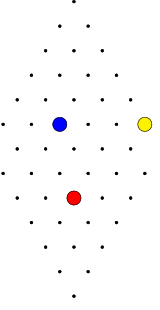
In the above, your jolt jumps your red, your blue, and your opponent's black. Then, since you jolted your red and your blue, you can move either or both of them. Here, you move your red first, and then you move your blue.